



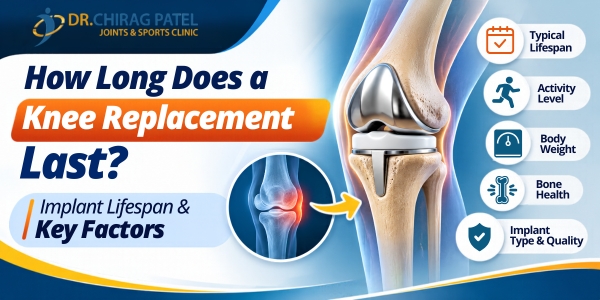
Knee replacement has completely changed what getting older looks like for people hitting their 60s and 70s. Over the last few decades, it has freed millions of older adults from grinding knee pain, once assumed to be non-negotiable.
Most knee replacement implants even outlived the patients:
The average age of patients undergoing knee replacement surgery was around 70 in the 2010s. Because knee replacement is considered a final resort, it meant pain-free living for the rest of their life.
Their less active lifestyle and lower daily demands helped them live long enough for most implants to outlast them. As a result, it is not yet clear how long these replacement implants last in relatively younger people with higher daily demands.
Knee replacement among people in their 40s–50s has doubled now
The average age of people undergoing knee replacement is now down to 62–63, which may still look like people in their 60s.
But this shift is taken seriously.
In fact, the number of people getting knee replacement surgery in their 40s–50s has nearly doubled, and for those in their 50s–60s, it has tripled. Knee implants must last longer while handling higher demands and wear and tear from an active lifestyle.
Will the new knee last as long as you need it to?
This is the one question we often get asked at our Orthopedic clinic in Mumbai, and the answer, as you may have known by now, is that it depends on age, activity, and the surgery as well.
But if you want a more detailed, practical answer about the mileage of knee implants and the best practices that make them last longer, this blog is for you.
With input from knee specialist doctor Dr Chirag Patel, we look at how long a knee replacement really lasts and what shortens or stretches its life today.
How long does a knee replacement last, according to most sources?
“Yes, this is one of the questions we are asked most at our clinic, often by families planning a parent’s surgery. Those figures are averages across large groups, mostly of older patients. Your own knee may do better or worse depending on a few specific factors: age and activity,” says Dr Chirag Patel.
“10 to 15 years is the common answer, but the long-term evidence is better than that. A 2019 review in The Lancet, based on national joint registries, found that about 82% of total knee replacements and 70% of partial ones were still in place after 25 years. So the range I would say is 10-25 years, and the exact answer depends on the age of the patient and how hard they use their knee,” he adds.
| Age at surgery | Low-impact life (walking, cycling, swimming) | Heavy work or high-impact sport |
| Over 70 | Usually lasts the rest of your life | Usually lasts the rest of your life. Falls are the bigger risk in this age group, |
| 60 to 70 | 20 to 25 years or more | Around 20 years. |
| Under 55 | About 20 years | 15 to 20 years, and a second operation is more likely |
Based on the Lancet study we mentioned above and the tables above, here’s what everyone must know about knee replacement implants:
Younger people have more years ahead, so they usually put more load on their knees. Over time, the plastic insert between the metal parts of the implant wears down, which can loosen the implant, and this may require a second surgery.
A second operation, a revision knee replacement surgery, is bigger than the first, more complex, and carries greater risks.
Knee Replacement Surgery: Your Chances of a Second Operation and What to Watch For
Age at knee replacement surgery makes one of the biggest differences. A Lancet study of more than 54,000 knee replacements in the UK put the lifetime risk of a second operation at about 5% for people over 70.
For men in their early fifties, the risk was estimated to be 35% (lower for women)
| Age at surgery | Lifetime chance of a revision | What to watch |
| Over 70 | About 1 in 20 | Bone strength and falls |
| 60 to 70 | Between the two | Weight, diabetes and how active you stay |
| Early 50s | Up to about 1 in 3 for men | Heavy work, deep squatting, and the decades the knee must last |
To summarize:
- For most people, a knee replacement lasts well over 20 years, and for many it is the only one they will ever need.
- A patient in their 40s or 50s can be considered young for knee replacement, and for them, the honest answer depends on the factors above and on how carefully the operation is planned.
- The earlier the operation is performed, the higher the need for proper care – without which a revision surgery may be needed, which is more complex and carries greater risk.
“The above information is based on hundreds of studies which were based on a large volume of surgeries. Though it is the best theoretical source we can bank on, it is an average estimation as well. Taking daily work, lifestyle habits, and overall health gives a clearer picture of what one can expect from knee replacement surgery,” says our knee specialist, Dr. Chirag Patel
At our Joints & Sports Clinic in Mumbai, consultant joint replacement surgeon Dr. Chirag Patel carefully weighs these factors to tailor a surgical plan that helps maximize implant lifespan and keep you moving pain-free for years to come. To find out what’s right for your knee, book a consultation with Dr. Chirag Patel today.