



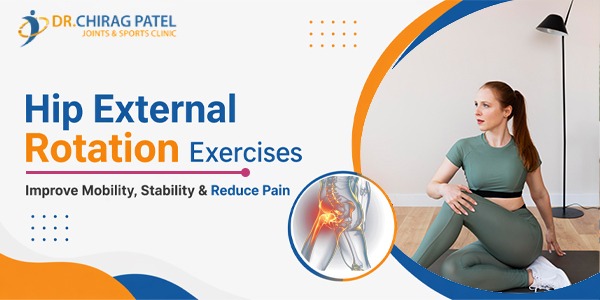
Some movements in the body go unnoticed until they stop working smoothly. Turning your leg outward, for example, feels simple until stiffness begins to interfere. You may notice it while getting out of a car or even while sitting cross-legged. That is when people start asking, what is hip external rotation?
It is not just a technical term. It is a movement your hip performs every day, often without you realising it.
Understanding The Movement Before Fixing It
External rotation simply means your thigh rotates away from the centre of your body. It sounds basic, yet this small action plays a role in balance, posture, and even how you walk.
When this movement becomes restricted, other parts of the body start adjusting. The knee may take an extra load. The lower back may begin to compensate. Over time, discomfort appears in places that do not seem directly connected.
That is why improving this movement is not only about flexibility. It is also about control.
Why These Exercises Feel Different From Regular Stretching?
Most people approach hip exercises expecting quick relief. That rarely happens here. The improvement is gradual, and sometimes it feels like nothing is changing at first.
Still, consistency makes a difference. The benefits of hip external rotation exercises are often noticed over time rather than immediately. Better joint control, smoother movement, and reduced strain on surrounding areas are some of the changes people report.
You may not notice it during the exercise itself. You feel it later, when daily movements become easier.
Where Stretching Fits Into The Routine?
Stretching plays a supporting role, but it is not the complete solution. A hip external rotation stretch can help release tight muscles, especially after long hours of sitting. However, without strengthening, the improvement does not last.
This is where people often get stuck. They stretch regularly, feel temporary relief, and then return to the same discomfort again. The body needs both mobility and strength to hold that mobility.
What You Should Pay Attention To While Practicing Hip External Rotation?
There is no perfect way that works for everyone. Some days your hip feels open, and on other days it feels restricted. That variation is normal.
Still, a few tips for safe practice can help you avoid unnecessary strain and keep your progress steady.
- Do not push the stretch further; move slowly.
- Quit when you experience resistance instead of pushing through pain.
- Maintain your posture without moving the pressure to the lower back.
- Concentrate on breathing, because tension can creep up without your awareness.
- Do not compare your range of motion with others.
- Train regularly rather than train in a single session.
- Have support when necessary, particularly when balancing.
- Lie on days when the hip is particularly tight or painful.
These arguments might appear to be elementary, but they are frequently overlooked. It is normally at that point that things start going wrong.
When Exercises by themselves are not enough ?
At some point, self-directed habits begin to become doubtful. When the discomfort remains the same or recurs, it might be time to dig deeper.
It is possible to consult a Hip Specialist in Mumbai and determine what exactly is restricting your movement. It is not necessarily stiffness. In other cases, it is joint alignment or muscle imbalance.
In more complex situations, the advice of the most qualified Hip surgeon in Mumbai might be needed, particularly in cases where structural problems are at play. Clarity at an early stage prevents complications in the long run.
Conclusion
Hip external rotation can be viewed as a minor aspect of motion, but it affects the level of comfort when performing daily tasks. It is not an easy task to improve, and the improvement is not always noticeable immediately. It is usually the case that staying consistent without coercion yields results in the long run.