



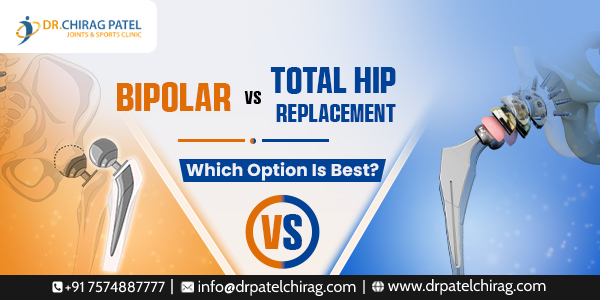
A hip fracture in an older person is not a minor injury. It can affect walking, balance, sleep, and even the ability to use the bathroom without help. In many cases, especially when the neck of the femur is displaced, the damaged joint needs to be replaced. This is where families often hear two terms: bipolar hip replacement and total hip replacement.
Both surgeries can help the patient walk again. However, they are not meant for the same type of patient.
What Happens In A Bipolar Hip Replacement?
In a bipolar hip replacement, the damaged head of the thigh bone is removed and replaced with an artificial component. The natural hip socket is not replaced.
This usually makes the surgery less extensive. It may involve less blood loss and can be suitable for older patients who were not very active before the fracture. It may also be considered when the patient has other medical conditions and cannot safely tolerate a longer operation.
A common question is, when is bipolar hip replacement recommended? It is generally considered for patients with lower physical demands, reduced mobility, poor overall health, or a shorter expected lifespan.
The limitation is that the artificial head continues to move against the natural socket. Over time, this may lead to socket wear, groin pain, or the need for another surgery.
How Is Total Hip Replacement Different?
Total hip replacement replaces both parts of the joint. The damaged femoral head is replaced, and an artificial cup is fitted inside the hip socket.
This option may suit active older adults who were walking independently before the fracture. Since both joint surfaces are replaced, the patient may experience better movement and comfort in the long term.
Research comparing the two procedures found better functional scores in active older patients who received total hip replacement with a dual mobility cup. However, this does not mean that every patient should receive the same surgery.
People often ask, is bipolar hip replacement better than total hip replacement? The answer depends on the patient. Bipolar replacement may be safer for one person, while total hip replacement may provide better function for another.
Why Does The Hip Implant Design Matter?
One concern with total hip replacement is dislocation. This means the artificial head comes out of the socket.
A dual mobility cup is designed to improve stability. It has two areas of movement, which can provide a wider range before the joint dislocates. This may be useful for older patients who are active but still have a higher risk of instability.
A total hip replacement specialist in Mumbai can decide whether a standard cup or dual mobility implant is more suitable. The decision depends on bone strength, muscle control, age, activity, and the type of fracture.
Age Alone Should Not Decide The Surgery
Two patients may both be 70 years old, but their needs may be completely different. One may live alone, travel regularly, and walk several kilometers every day. The other may already depend on family members for basic movement.
This is why the surgeon must look at the patient’s life before the fracture. Dr Chirag Patel’s approach focuses on hip function, medical fitness, mobility goals, and recovery potential before recommending surgery.
Patients looking for the best orthopedic surgeon for hip replacement in Mumbai should choose someone who explains both options honestly. The aim should not be to use the most advanced implant in every case. The aim should be to select the option that gives the patient the safest and most useful recovery.